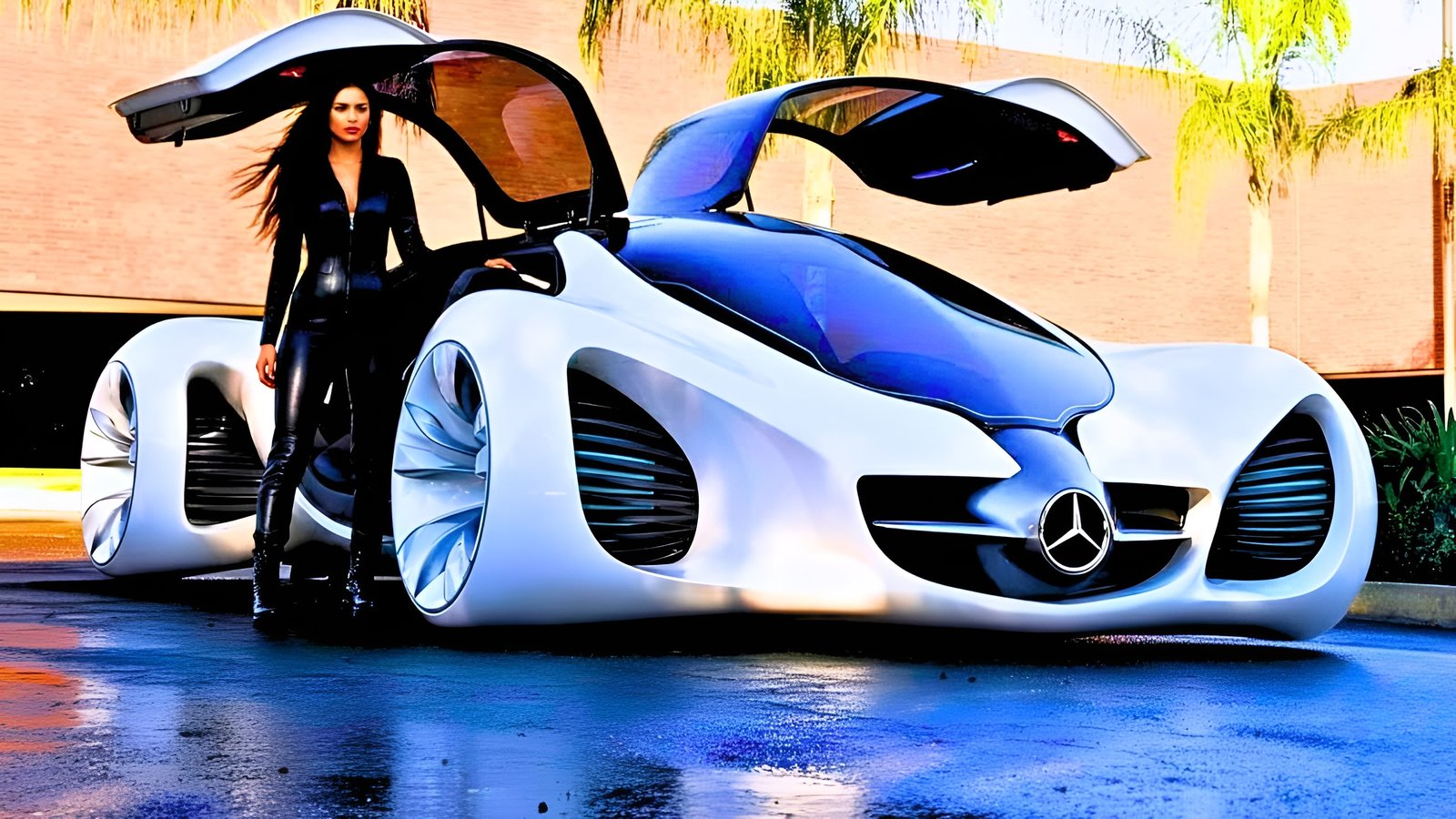
Mercedes-Benz BIOME: When Mercedes Benz first unveiled the BIOME concept, it was more than just another futuristic design study. It was a bold statement about the future of mobility and the possibilities that open up when technology, nature, and imagination are allowed to blend. The BIOME aimed to answer a simple but powerful question: what if a car could grow like a plant, live in harmony with its surroundings, and leave no harmful footprint behind It was a radical departure from traditional automotive engineering and an experiment that continues to spark curiosity years later.
The BIOME concept emerged from the Advanced Design Studio in California, a creative playground where designers are encouraged to push beyond conventional boundaries. Instead of imagining what the next generation of cars might look like within existing rules, the team behind the BIOME reimagined those rules entirely. The result was a vehicle that challenged our understanding of materials, manufacturing, and sustainability.
A Car That Grows Instead of Being Built
One of the most remarkable ideas behind the BIOME concept was the suggestion that the car could be grown from a special biological material rather than assembled on a factory line. This material, known as BioFibre in the concept narrative, would theoretically be cultivated from seeds. These seeds would produce structures that form the framework of the car, eventually growing into a complete vehicle.
The thought of planting a seed and watching it grow into a car is almost surreal, yet within the world of conceptual design it becomes a fascinating exploration of what might be possible in a future where organic engineering advances far beyond what we know today. The designers envisioned a process where specific DNA instructions would determine the car’s shape, thickness, and structural reinforcements. Instead of welding steel or molding plastic, the BIOME would emerge naturally, guided by tailored genetic information.

Lightness Redefined Through Organic Material
The BIOME concept emphasized extreme lightness, not only for efficiency but also as a method to reduce environmental impact. The BioFibre material imagined for the car was envisioned to be stronger than steel yet lighter than traditional composites. This hypothetical strength to weight ratio would allow the BIOME to perform like a high end sports vehicle while consuming far less energy.
A lightweight body reduces the power required for acceleration, braking, and handling, which in turn reduces the environmental footprint of driving. Although BioFibre remains a fictional material for now, the idea behind it continues to inspire real world researchers working on biodegradable composites and natural fiber reinforcements. Innovation frequently begins with imagination, and the BIOME provided exactly that kind of spark.
A Fully Integrated Relationship With Nature
One of the central themes woven into the BIOME concept was harmony with nature. Not only would the car be grown from organic materials, but Mercedes Benz also imagined a system in which the BIOME could contribute positively to the environment during its lifetime. In the concept story, the vehicle would absorb sunlight and convert it into energy, functioning similarly to photosynthesis in plants. This life inspired system would create a near zero impact driving experience.
The idea extended beyond energy use. The lifecycle of the BIOME was imagined to be fully sustainable. When no longer needed, the vehicle could theoretically be composted or returned to nature without producing pollution or waste. This vision stands in stark contrast to the automotive waste challenges we face today, where scrapped vehicles create significant environmental concerns. Even if the BIOME itself remains a conceptual dream, the mindset it represents pushes the industry to think more seriously about full lifecycle sustainability.

A Glimpse Into the Future of Automotive Design
The styling of the BIOME was as imaginative as its materials. With smooth, flowing lines inspired by nature, the car appeared almost alive. The organic shapes suggested a vehicle shaped by natural forces rather than industrial molds. The design featured flowing surfaces that felt grown rather than carved, and the overall aesthetic echoed the organic forms found in plants and animals.
Inside, the BIOME concept continued its natural inspiration. The cabin was imagined as part of the living structure of the car, shaped by the same materials and principles. Transparency, soft curves, and seamless transitions between elements helped create an interior that felt both futuristic and organic. Although the interior was never built as a full working model, the visualizations hinted at a driving experience unlike anything on the road today, closer to stepping inside a living organism than entering a machine.
Why Concepts Like the BIOME Still Matter Today
It is easy to view extreme concept ideas like the BIOME as pure fantasy, but they play an important role in the evolution of design and technology. By pushing far beyond what is currently possible, they give engineers and designers permission to imagine without limits. These ideas eventually influence real world solutions in unexpected ways.
Sustainability has become a central focus across the automotive industry. Advanced materials, recyclable components, bio based plastics, and cleaner manufacturing processes are no longer niche experiments. They are mainstream priorities. Many of these innovations echo ideas introduced by radical concept studies such as the BIOME. Even if no car will be grown from seeds anytime soon, the principles of lightweight construction, renewable materials, and integrated environmental harmony remain crucial.

The BIOME also reminds us that progress does not always come from incremental improvements. Sometimes it requires a leap into the unknown. While most concept cars showcase futuristic styling or advanced technology, few dare to rewrite the fundamentals of how a vehicle exists. The BIOME did exactly that, and its spirit continues to influence forward thinking designers and engineers who aim to merge nature and mobility in meaningful ways.
The Legacy of a Radical Idea
More than a decade after its debut, the Mercedes Benz BIOME remains one of the most imaginative concept cars ever created. It stands as a symbol of what happens when creativity is allowed to stretch far beyond conventional limits. Although it may never reach production, its influence can be felt in conversations about sustainability, biomimicry, and the future of automotive materials.
In many ways, the BIOME is less a prediction and more a provocation. It challenges us to rethink our assumptions about manufacturing, energy, and our relationship with the natural world. It asks what mobility could look like if we embraced harmony with nature rather than dominance over it. Most importantly, it shows that the future of transportation can be more than mechanical evolution. It can be imaginative, organic, and deeply connected to the world we live in.

